World Mental Health Day 2025
By Chloe Hall
Each year, World Mental Health Day falls on October 10th. The day’s theme and events are organised by the World Federation for Mental Health (WFMH) and the World Health Organisation (WHO). This year’s theme is ‘Mental Health in Humanitarian Emergencies’.
Across the globe there are many ongoing catastrophes and emergencies, all of which severely impact on the mental wellbeing of countless people. Experts confirm that almost a quarter of those affected by war or conflict over the past decade continue to experience forms of depression, anxiety, PTSD, bipolar disorder or schizophrenia today.
These same emergencies, whether the result of natural disaster, military conflict or political upheaval, often totally disrupt local health care services, as well as personal livelihoods and routines. Families are inevitably separated, infrastructure and customary networks are disrupted and many people are forced to leave their homes. Moreover, conflicts and emergencies cause personal loss and tragedy, exacerbate poverty and heighten tension within communities. It is unsurprising that psychological distress is the result for so many. In terms of mental health, this all means that every year millions of vulnerable people are left without vital support, treatment and advice.
What action is the WFMH calling for?
The WFMH is calling for a number of global policy responses to disasters and emergencies:
First, mental health should be centralised in formulating contingency plans to relieve crises.
Second, communities need to be empowered to self support and help. This would centralise vulnerable people and include anyone with mental health needs.
Third, key emergency workers require mental health first aid training to help support anyone experiencing sudden and severe distress.
Fourth, mental health care needs to be readily available at health facilities. Trained community members should be central to this initiative.
Fifth, the rights of anyone with mental health needs must be safeguarded.
Sixth, networks between health specialists, care providers, schools and social services need to enshrine mental wellbeing.
How countries are reconstructing for good
There is no doubt that centralising mental health systems and focused responses to disasters and emergencies are crucial steps to foster social and economic recovery for individual people, local communities and entire countries. Here are three examples:
In Syria, mental health support has been successfully rolled out into health and care services in at least a dozen cities, despite ongoing conflict.
Since the 2004 tsunami, Sri Lanka has overseen huge improvements in mental health care. Today, each of the country’s civic districts has mental health services. This contrasts with just thirty three percent in 2004.
In 2013, Typhoon Haiyan left widespread destruction in its wake. In the subsequent decade, areas worst affected have witnessed fresh government and WHO backed mental health initiatives. In particular 1,300 community health-care providers have been trained to help treat those with ongoing mental health conditions.
Current responses
The WFMH and the WHO are continuing to coordinate effective mental health responses to disasters and emergencies. The ambition remains to strengthen mental health services, where facilities have broken down, by providing expert advice and training. There are ongoing operations in Afghanistan, Chad, the occupied Palestinian territory, Ukraine, and Yemen.
Conclusion
In 2024, the World Health Assembly approved a resolution to strengthen mental health support and planning in every stage of responding to emergencies. This commitment is intended to provide high quality, integrated services which can be rolled out to everyone. Such support has never been more needed. And while 10th October gives one day’s publicity and focus to these issues, naturally they remain of vital importance every day.
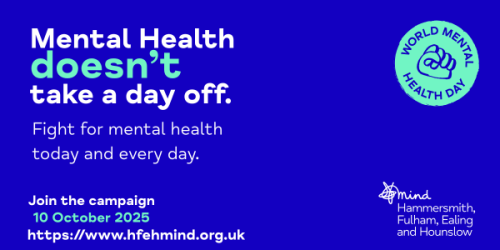
Fight for mental health today, and every day
Mental health is more than a small part of our lives – it’s every moment of every day. It’s a hard day’s work and a catch-up with friends. It’s when you become a parent and the day you lose someone you love. It’s the times you reach out for support and the years you spend on a waiting list. It’s the fight for a mental health system that works and hospitals that are safe.
Mental health matters on the days when everything happens and the days when nothing happens. When life is busy and unpredictable and when it’s quiet and ordinary too. That’s why we fight every day, to support more people tomorrow.
10 October is World Mental Health Day, but we want everyone to understand that mental health is important every day. Together we can make sure everyone sees it that way.
Find out ways to support the campaign here
Posted on: 6th October 2025